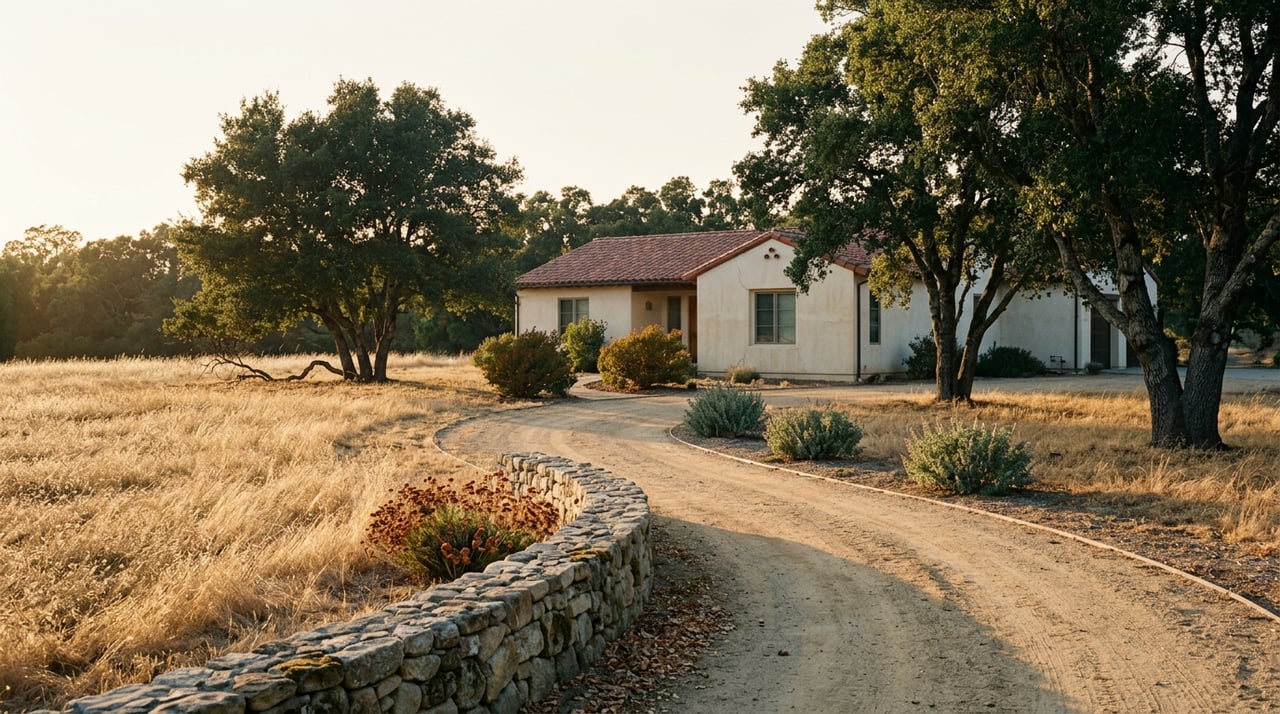
Two listings can say the same thing and mean different things. A 2.5-acre parcel on the west side of Atascadero and a 2.5-acre parcel on the county's edge of town both read the same on paper: same acreage, same general zoning language, same asking price range. Then escrow opens, and one buyer gets a routine title package while the other gets a form from a water company they've never heard of.
That water company is real, and it is 113 years old. It didn't show up because of some new state mandate or a quirky HOA. It's the leftover machinery of a planned community that stopped being a company town in 1979 but never stopped running on the plumbing its founder built.
If you're shopping for land or acreage around Atascadero, the fact that matters most isn't the number of acres on the listing sheet. It's which side of a set of invisible lines, drawn across a hundred years, that acreage happens to sit on.
A magazine publisher platted the roads before anyone lived on them
Atascadero exists because a magazine publisher named E.G. Lewis bought roughly 23,000 acres of Rancho Atascadero in 1913 and set out to build a planned utopian colony from scratch. His survey crews platted the entire property in 1914, laying out close to 100 miles of roads, orchard tracts, and residential lots sized for what the original marketing called "elbow room." The city that incorporated decades later, in 1979, still covers about 15,600 acres of that original roughly 29,980-acre Colony footprint, and its general plan says the quiet part out loud: new development is meant to conform to the historic Colony land use patterns, with the downtown ringed by neighborhoods that step down into lower-density rural land the further you get from the center.
That's not nostalgia written into a planning document. It's a working policy. It's why a lot near the 1918 Administration Building behaves differently than a lot with the same acreage a mile toward the hills, even though both trace back to the same 1914 survey.
The company that outlived the company town
Here's the piece that catches buyers off guard. When Lewis platted the Colony, he also incorporated a mutual water company on August 13, 1913, to serve it. That company, the Atascadero Mutual Water Company, is still the one running the taps. It is not a city utility. It is a mutual corporation, which means the people it serves are also its shareholders, and it exists to deliver water to those shareholders at cost rather than for a profit margin. Today AMWC serves more than 30,000 residents through roughly 250 miles of pipeline, 17 active wells, and nine storage tanks, and it still describes itself as serving "the colony since 1913."
The clearest illustration of how far this reaches is a parcel most buyers will never tour: Eagle Ranch. The city's own general plan identifies roughly 400 undeveloped Colony lots on the city's edge that are already entitled to water service as shareholders in the Atascadero Mutual Water Company, sitting under Williamson Act agricultural contracts until those contracts expire. Four hundred lots, already carrying a water entitlement, waiting on a legal clock rather than a construction permit. That's what a Colony-era water right looks like when nobody has built on it yet.
The line that decides whether "rural" means quiet or means complicated
Atascadero's General Plan draws a second line that matters just as much as the water company's shareholder rolls: the Urban Reserve Line, which roughly follows the historic Colony boundary, and inside it, the tighter Urban Services Line. Inside the Urban Services Line, the city wants infill, because services like drainage, emergency response, and street maintenance can be delivered efficiently. Outside it, in what the plan calls the Rural Services Area, the intent is the opposite: retain rural residential character and open space, on purpose, as a matter of policy.
Layered underneath that is a set of zoning categories that sound similar but aren't. According to Atascadero's zoning code, the Residential Suburban zone requires a minimum lot size of two and a half acres, and that minimum can climb as high as ten acres depending on performance standards tied to things like distance from the center of town and septic suitability. Move further out into unincorporated county land that still traces back to the Colony's original grasslands and scattered oaks, and the county's own rural land categories take over, with different acreage minimums and different rules for animals, wells, and septic.
None of that shows up as a difference in the listing photos. A buyer comparing "2.5 acres, Atascadero" against "2.5 acres, Atascadero" is often comparing a parcel meant to receive city services against a parcel the general plan has deliberately positioned to stay rural, undersized on paper for what the performance standards will ultimately allow.
Where the state's newest housing tools quietly stop working
California's SB 9 was supposed to make it easier to add a second unit or split a single-family lot almost anywhere. Atascadero adopted its own SB 9 ordinance to implement that state law, but the city's own list of local concerns tells you exactly where the tool runs out of road. Areas not served by sewer are flagged directly as a concern for local SB 9 application, and, as Atascadero News reported, the city has been explicit that a septic-served dwelling needs a full gross acre, not just the half acre septic itself requires, once you account for easements and access. On top of that, according to Atascadero's SB 9 code, an urban lot split only qualifies if the parcel sits within or partially within an urbanized area as the U.S. Census Bureau defines it, which is exactly the kind of technical boundary that a Colony-fringe acreage parcel, still on septic, still outside that census-defined edge, is likely to fail.
So the same policy can leave a Colony-fringe acreage owner with fewer options, not because the land is worse, but because it sits outside a boundary that has nothing to do with the quality of the dirt.
What this actually changes depending on what you're buying
If you're looking for a custom home site with room to breathe, the Colony's own general plan language is doing you a favor. Its stated goal is to "preserve the rural atmosphere of the community and assure elbow room," and that policy is why larger, oak-studded parcels still exist close to a functioning downtown instead of having been subdivided into tract lots decades ago. The tradeoff is that you'll want your own well or a confirmed AMWC connection path, and you'll want to confirm legal lot status before you assume the parcel can be built on at all, since 1914-era plats predate modern subdivision review.
If you're evaluating raw acreage as an investment, the SB 9 and urbanized-area boundaries are the numbers that actually matter, more than any acreage total on a flyer.
And if you already own Colony-era land, whether it's a modest in-town lot or a larger holding closer to the hills, the water company relationship and the lot's legal status are exactly the two things a serious buyer's agent will ask about before writing an offer. Knowing the answers before you list tends to move a transaction faster than finding out during someone else's due diligence.
A few quick answers
Does every Atascadero property come with Atascadero Mutual Water Company shares? Confirm the specific parcel's status with AMWC directly rather than assuming it from the address.
Can I just add an ADU on a rural Atascadero lot? It depends on sewer versus septic and lot size. The city's own planning division treats areas not served by sewer as a flagged concern, so this is worth confirming before you fall in love with a plan for the land.
Is county land near Atascadero the same as land inside city limits? No. Land outside the Urban Reserve Line falls under San Luis Obispo County zoning and general plan rules rather than the city's, with its own minimum lot sizes and septic standards. The Colony's original footprint stretches across both jurisdictions.
Acreage math is the easy part. Legal lot status and the line between urbanized and rural are what actually decide what you can do with the land, and none of it is visible from a listing photo. If you're weighing a Colony-era lot, a fringe acreage parcel, or land you already own and are wondering what it's really worth in today's market, that's exactly the kind of homework The Mike Oliver Group does before an offer goes in, not after. Request Your Home Valuation and let's find out what your parcel's history actually allows.
This article is general information, not legal, tax or financial advice. Consult a qualified professional about your situation.