Buying land in Nipomo can feel exciting right up until the questions start piling up. Can you build on it? Is there water service? Does the parcel need septic, a well, or special county review? If you are thinking about buying land or acreage in Nipomo, understanding these steps early can save you time, money, and stress. Let’s dive in.
Why Nipomo land requires extra homework
Nipomo is an unincorporated community, which means land use is governed by San Luis Obispo County rather than a city planning department. That matters because what you can do with a parcel depends on county land-use categories, zoning rules, planning-area standards, and other property-specific factors.
The Nipomo Community Plan also makes clear that development capacity is closely tied to water supply, sewage disposal, and transportation improvements. In other words, a parcel that looks promising on paper still needs practical utility and access answers before you move forward.
Start with the parcel basics
Before you fall in love with a piece of land, start with the basics the county expects buyers to confirm. This gives you a clearer picture of whether the property matches your plans.
Confirm the APN and location
First, verify the parcel’s Assessor’s Parcel Number and exact location. This helps you research the right county records and avoid confusion with neighboring acreage that may have different zoning, utility service, or access conditions.
Check inland or coastal status
San Luis Obispo County advises buyers to first determine whether a parcel is in the Inland Area or the Coastal Zone. That one detail can affect which review process applies and what permits may be required before development.
For parcels in the Coastal Zone, the process is different. The county states there is no Site Plan Review in the Coastal Zone, and development generally may not begin until a coastal development permit has been issued by the appropriate authority.
Review zoning and land-use category
Once you know the parcel location, review the zoning and land-use category, allowable uses table, planning-area standards, combining designations, and any recorded maps. This step helps you understand whether the parcel may support your intended use, whether that is a home site, a future custom build, or another allowed use.
Make sure the parcel is a legal lot
This is one of the most important steps in any land purchase. San Luis Obispo County says a parcel must be a legal lot before it can be built on, graded, or subdivided.
That means you should not assume a long-existing parcel is automatically ready for development. In older acreage transactions, the county may rely on deed history, approved maps, and title records to determine legal creation.
What a certificate of compliance does and does not do
A certificate of compliance can recognize that a parcel was legally created. However, the county also states that it does not guarantee buildability and does not give you the right to start construction.
That distinction matters. A legal parcel may still have issues related to utilities, access, setbacks, grading, or permit requirements.
Helpful documents to review
To evaluate lot legality, buyers should typically review:
- A preliminary title report
- County recorder deed history
- Approved parcel or subdivision maps
- Easement information
The county also notes that roads, streets, and utility easements do not create separate legal parcels. If there is any uncertainty, an optional pre-application meeting with the county can help identify issues before you spend more money on design or due diligence.
Verify water and sewer service early
In Nipomo, water is often one of the first big questions. Some parcels may be within a public provider’s service area, while others may need a private well.
The Nipomo Community Services District, or NCSD, states that it operates one water system and two sewer systems. NCSD also says it is currently accepting applications for water and sewer service within its service boundaries.
Check the service boundary
Service availability is boundary-specific, so do not assume that a parcel with a Nipomo address automatically has NCSD water or sewer access. The county advises buyers to use its water-systems map viewer to identify the provider for a parcel based on location.
If the parcel is inside a service area, you can then confirm application procedures and service requirements. If it is outside a water purveyor boundary, the county says the property will likely need a private groundwater well.
Know Nipomo’s local water wrinkle
Nipomo has an added local requirement for some new development. The county says wells that serve new development overlying or using water from the Nipomo Mesa Water Conservation Area must have a meter installed, and that meter must be verified before a building permit is issued.
That is an important detail for buyers planning to build on acreage outside a public water system. It is one more reason to verify water feasibility before you remove contingencies.
Understand well and septic requirements
If public utilities are not available, you will likely need both a well and an onsite wastewater system. These are not small details. They are major parts of your feasibility review.
Well permits come first
San Luis Obispo County requires an approved well permit before drilling can begin. The county’s well application packet also calls for a scaled plot plan showing nearby property lines, easements, roads, wells, sewers, private sewage-disposal systems, and other potential contamination sources within a 200-foot radius.
That means the site itself and nearby conditions both matter. A parcel may have enough acreage but still need careful planning for well placement.
Septic approval needs testing
For septic, the county’s Local Agency Management Program sets the standards for onsite wastewater treatment systems. Residential permit submittals typically include:
- A site plan
- Septic design
- Percolation test
- Soils investigation
- Geotechnical or engineering reports when needed
This is one reason raw land purchases often take more due diligence than existing homes. The land has to prove it can support the systems your future project will need.
Review access, driveways, and right-of-way issues
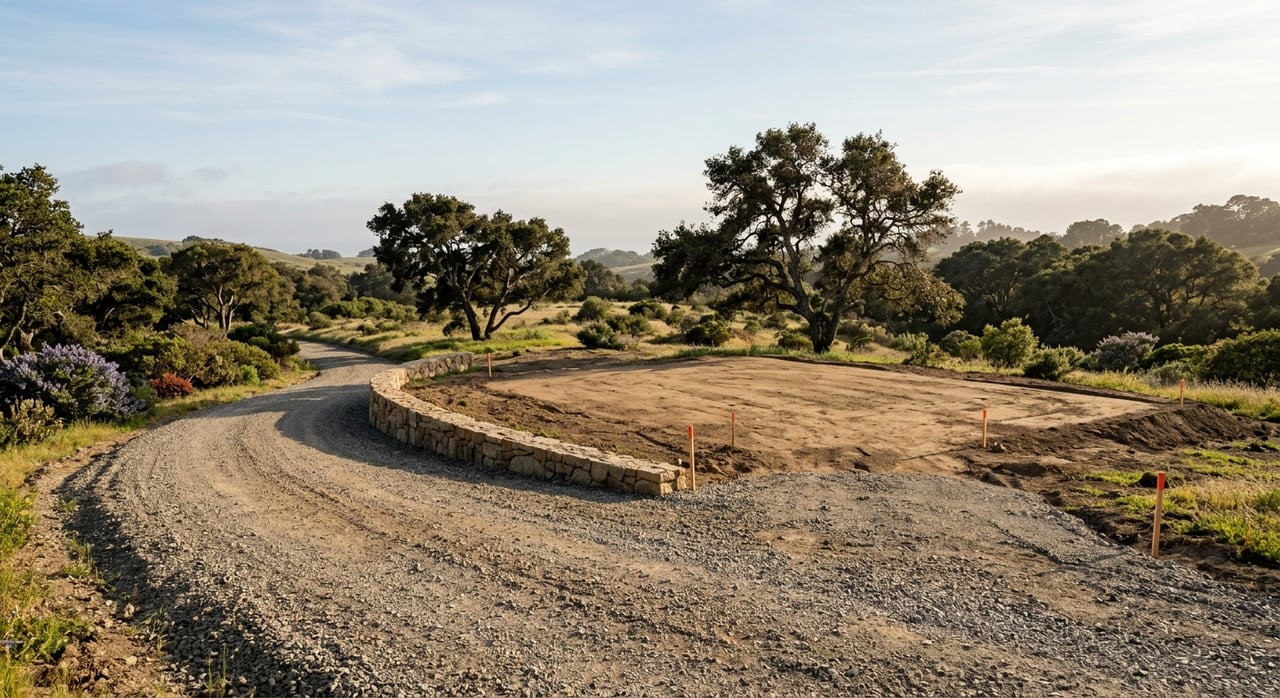
A parcel is not just about what happens inside the property lines. Access matters too, especially on larger lots and rural roads.
County Public Works says building-permit review includes drainage, stormwater, erosion control, flood hazard, and driveway encroachment review. If your project touches county right-of-way, an encroachment permit is required.
Driveway and road issues can affect cost
Driveway work is a standard encroachment category, which means even basic access improvements may need review and approval. In some parts of the county, road fees may also apply, and curb, gutter, or sidewalk requirements can apply in urban reserve areas and new subdivisions.
For buyers, this is where early planning pays off. Access improvements can affect both budget and timeline.
Follow a smart due diligence sequence
When you buy land in Nipomo, the order of your research matters. San Luis Obispo County’s guidance points to a practical sequence that helps you identify major problems before you commit.
Recommended order for buyers
Use this checklist as a starting point:
- Confirm the APN and legal lot status
- Verify whether the parcel is in the Inland Area or Coastal Zone
- Review zoning, land-use category, and any combining designations
- Ask planning whether a land-use permit is needed before a building permit
- Verify water and sewer availability, or well and septic feasibility
- Confirm driveway access, right-of-way needs, drainage issues, and possible road fees
This approach helps you move from the legal and planning questions to the practical construction questions. That can make your contingency period much more productive.
Watch for parcel-specific utility obligations
Not every Nipomo property has the same utility structure. Some parcels are within County Service Area 1, which funds drainage and sewer-collection maintenance and wastewater disposal pass-through costs.
That means two parcels with the same town name may still have different obligations or service frameworks. It is worth checking these details early so you have a more complete ownership picture.
Why local guidance matters in Nipomo land deals
Land and acreage purchases often look simple from the outside, but the real work is in the details. In Nipomo, those details can include county planning review, lot legality, utility boundaries, well and septic feasibility, Coastal Zone rules, and access permits.
If you are buying with a future build in mind, taking a careful, step-by-step approach can protect your investment and help you avoid surprises. Working with a local team that understands San Luis Obispo County land transactions can make the process more manageable from the start.
If you are considering land or acreage in Nipomo, The Mike Oliver Group can help you navigate the process with local insight and hands-on guidance.
FAQs
What should you check first when buying land in Nipomo?
- Start by confirming the APN, legal lot status, and whether the parcel is in the Inland Area or Coastal Zone.
Can you build on any legal parcel in Nipomo?
- No. San Luis Obispo County says a parcel must be a legal lot to be built on, but legal status alone does not guarantee buildability.
How do you know if a Nipomo parcel has water and sewer service?
- Check the parcel location against the county water-systems map and confirm whether it falls within a provider boundary such as NCSD.
What happens if a Nipomo land parcel is outside a water service area?
- The county says the parcel will likely need a private groundwater well, and an approved well permit is required before drilling starts.
What does a Nipomo buyer need for septic approval?
- Residential septic submittals typically include a site plan, septic design, percolation test, soils investigation, and sometimes geotechnical or engineering reports.
Do access and driveway issues matter when buying acreage in Nipomo?
- Yes. Public Works review may include drainage, stormwater, flood hazard, and driveway encroachment, and work in county right-of-way requires an encroachment permit.